Deworm the World Initiative
Short description
Helps governments treat schoolchildren for parasitic worms at national scale
Organisation
Evidence Action is a nonprofit headquartered in Washington, D.C. that delivers a small number of well-evidenced health programmes at large scale. This page concerns the Deworm the World programme only; the organisation also runs Safe Water Now, Equal Vitamin Access and Syphilis-Free Start, among others.1
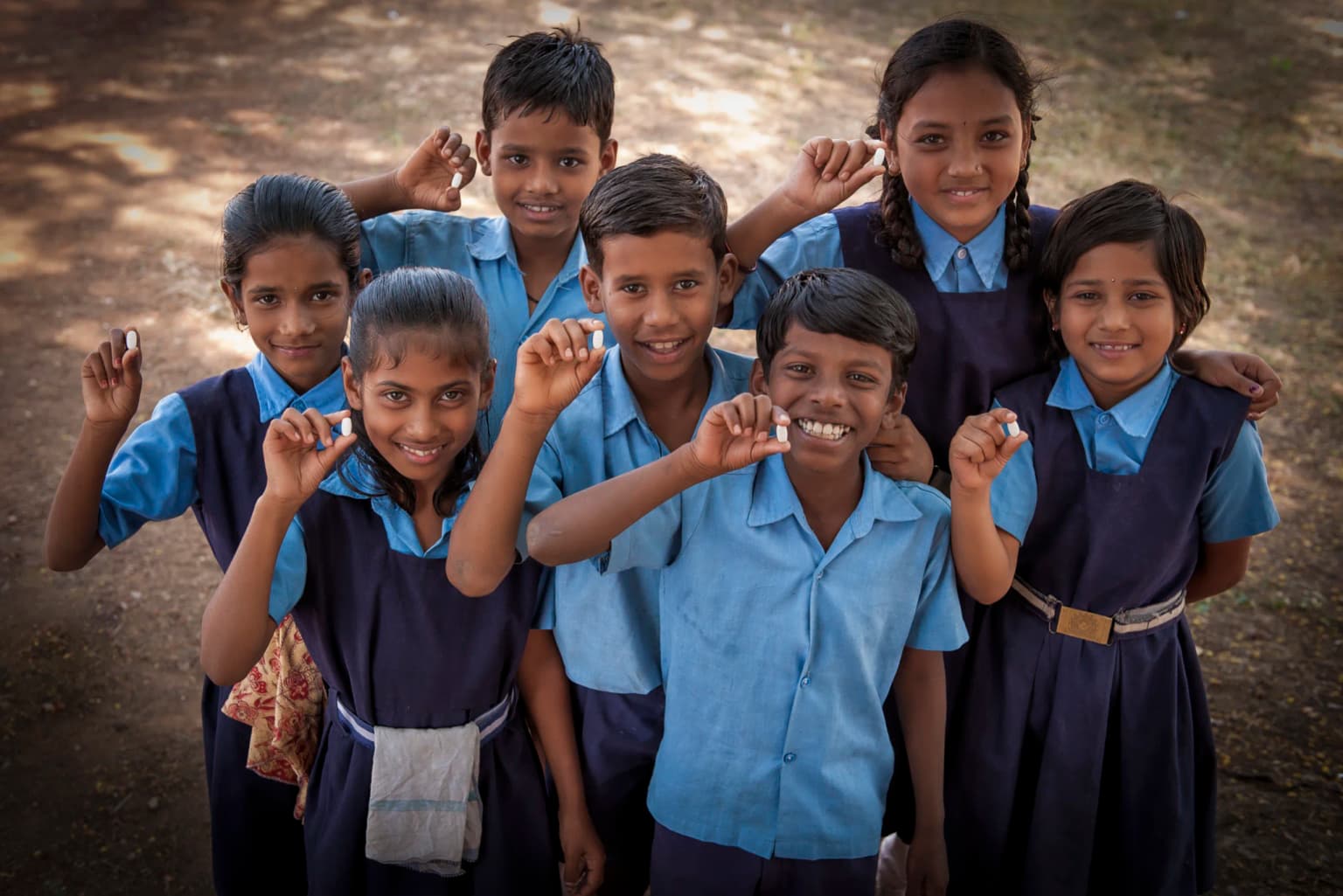
Deworm the World does not distribute treatment itself. It provides governments with technical and financial assistance to run school- and community-based mass drug administration against soil-transmitted helminths (STH) and schistosomiasis. Treatment runs in India, Kenya, Nigeria, Pakistan and Malawi; in Tanzania the partnership begins with a survey of worm burden.2
The problem: worm infections
The WHO estimates that around 1.5 billion people are infected with soil-transmitted helminths, roughly 24% of the world's population. By WHO figures, 654 million school-age children live in areas of intense transmission and need treatment.3
The worms draw blood and nutrients from the body. The WHO lists anaemia, malnutrition and impaired physical and cognitive development as consequences; very heavy infections can cause intestinal obstruction requiring surgery.3 The communities affected are overwhelmingly those without reliable access to clean water and sanitation.
There is a funding problem on top of that. Evidence Action puts the fall in official development assistance for neglected tropical diseases at 41% between 2018 and 2023, before the USAID cuts, and points to the WHO's 2025 Global NTD Report, which describes programmes worldwide as severely disrupted.2
Approach
Rather than building its own delivery system, Evidence Action works through ministries of education and health, using structures that already exist, above all schools and trained teachers. The organisation describes its support as covering training cascades, prevalence surveys, help with drug procurement, third-party monitoring and community awareness work.2
Treatment is albendazole or mebendazole, and praziquantel against schistosomiasis. The drugs are WHO-recommended, are donated to endemic countries through the WHO, and can be administered by non-medical staff.3 Because side effects are minor, the whole target group is treated without testing individual children first; diagnosing each child would cost more than treating them.4 Families pay nothing.1
Impact
Evidence Action reports having supported more than 2.2 billion treatments since 2014,2 most recently around 198 million in 2024 across India, Kenya, Nigeria, Pakistan and Malawi.1 It puts the average cost at under $0.50 per treatment, and as low as 7 to 8 cents in some programmes, and its own modelling puts the return at roughly $169 in later earnings for every dollar invested.2
GiveWell's figures are more conservative. Its August 2022 review estimates $0.66 per child in Kenya, or $0.46 excluding in-kind contributions from governments, and roughly half that in India.5 In the May 2025 grant decision, GiveWell compares the programmes to an equivalent cash transfer: 11 to 15 times the value in Nigeria, 10 times in Khyber Pakhtunkhwa. Both figures come from its 2024 analysis and were not recalculated for that decision, and the 10x figure sits exactly at the funding bar GiveWell applied at the time.4
The evidence base traces back to a randomised trial in Kenya by Michael Kremer and Edward Miguel. Evidence Action summarises the findings as a 25% reduction in school absenteeism among treated children and, twenty years on, a 13% higher income among those who received two to three additional years of treatment. A 2022 meta-analysis also finds an average weight gain of 0.3 kg.1
Transparency
Evidence Action publishes prevalence and coverage surveys and submits them to GiveWell for review. GiveWell credits the programme with consistently strong monitoring and a median treatment coverage in Nigeria of 77% between 2016 and 2022, above the WHO target of 75%.4
GiveWell listed Deworm the World as a top charity from 2013 to 2022. In August 2022 it changed the criteria for that list and removed the programme. By its own account this was not a reassessment of the programme but a shift towards interventions with a more certain causal chain; Deworm the World remains eligible for All Grants Fund money.5
The May 2025 position is blunter: deworming is no longer a priority intervention area, and GiveWell intends to withdraw in stages. The reason lies in the programmes' own success. Where deworming has run for years the worm burden has fallen sharply, and on this assessment it can no longer quantify how much further rounds of treatment achieve. In Kenya, STH prevalence fell from 32.3% in 2012 to 5.8% in 2021/2022, according to the survey by Evidence Action and the Kenya Medical Research Institute.4
What is striking is how openly GiveWell states the limits of its own analysis. Its cost-effectiveness model assumes the infection risk that applied before the programmes began, which it says means the model likely overestimates the benefit of continued deworming in Kenya. How far infections return once treatment stops is unsettled: the DeWorm3 trial found higher prevalence in some areas and age groups after a two-year interruption, but GiveWell records that it could not clearly locate those reported findings in the published paper, and names the risk of rebound as its own reservation about exiting Kenya.4 Already in 2024 it had noted that its weighting of long-run income effects makes it an outlier among funders, and that it may therefore be missing something.6
Current projects
GiveWell's May 2025 decision covers $1.4 million for 2027, split between Kenya ($830,000), Nigeria ($300,000) and Pakistan ($250,000).4
Nigeria
Funding for Lagos ended in 2025. After seven years in Cross River, Evidence Action reports STH prevalence down 49% and schistosomiasis down 75%, which led the state to reduce treatment frequency in low-burden areas.2 GiveWell considers these programmes still cost-effective because worm burden in most local government areas remains moderate.4
Kenya
Final year of GiveWell funding. Evidence Action is developing an exit strategy with the government so that treatment and surveillance continue at smaller scale under state ownership.4 Following the 2021/2022 survey, 10 of the 27 counties are below 2% prevalence, the threshold at which mass treatment can be suspended.2
Pakistan
Also the final year; GiveWell gives borderline cost-effectiveness and the high demand on its own capacity as the reasons for exiting.4 Nationally the programme reaches around 14 million children a year by Evidence Action's account. A national impact survey began in October 2025, the Khyber Pakhtunkhwa provincial government has committed to covering 20% of the annual implementation budget for three years, and Evidence Action estimates that three to five further treatment rounds would allow a handover to government. Without additional funding it may wind down early.2
India
On National Deworming Day in August 2025, Evidence Action reports 146.8 million children treated. Surveys across eleven states show marked declines: Himachal Pradesh and Rajasthan below 1%, Chhattisgarh down from 75% to 14%. All Indian state programmes are expected to run independently by March 2027.2
Malawi
An integrated school health programme running since 2024, combining deworming with iron and folic acid supplementation, which the organisation reports cuts costs by 12%; it also reaches 1.3 million adolescent girls. 8.5 million treatments are planned over three years. Evidence Action is seeking partners to continue the programme to 2030.2
Tanzania
More than 10 million children are considered at risk. The first nationwide prevalence survey in over 20 years is planned for 2026, to concentrate treatment on high-burden districts; Founders Pledge is funding the start.2
Why the Wealth for the World Fund funds Deworm the World
What decides it is that both halves are demonstrated here: that the treatment works, and that it arrives. The causal chain from tablet to reduced worm burden rests on randomised trials with twenty years of follow-up, and the programme evidences the fall in prevalence through its own externally reviewed surveys rather than asserting it. GiveWell's withdrawal from Kenya and Pakistan is not an objection to that but a consequence of it: where deworming has run for years, burden has fallen so far that the benefit of further rounds can no longer be quantified. Where it is still high, in Nigeria, Malawi and Tanzania, treatment remains one of the cheapest ways there is to durably improve a child's health. That is why the Wealth for the World Fund pays out to Deworm the World.
Footnotes
-
Evidence Action, "Deworm the World". evidenceaction.org ↩ ↩2 ↩3 ↩4
-
Evidence Action, "Don't gamble away remarkable NTD gains". evidenceaction.org ↩ ↩2 ↩3 ↩4 ↩5 ↩6 ↩7 ↩8 ↩9 ↩10 ↩11
-
World Health Organization, "Soil-transmitted helminth infections", 18 January 2023. who.int ↩ ↩2 ↩3
-
GiveWell, "Evidence Action's Deworm the World Initiative — 2027 Funding for Nigeria, Kenya, Pakistan (May 2025)". givewell.org ↩ ↩2 ↩3 ↩4 ↩5 ↩6 ↩7 ↩8 ↩9
-
GiveWell, "Evidence Action's Deworm the World Initiative – August 2022 version". givewell.org ↩ ↩2
-
GiveWell, "Evidence Action's Deworm the World — Renewal Grant for Nigeria, Pakistan, Kenya, and India (March 2024)". givewell.org ↩
All Donation Partners
Discover all organizations supported by Wealth for the World
Support Deworm the World Initiative
With your donation to Wealth for the World, you can sustainably support Deworm the World Initiative and other effective organizations
Organization's Website
Learn more about the mission and impact of Deworm the World Initiative directly on their website
GiveWell Analysis
View detailed impact research and cost-effectiveness analysis from GiveWell
Related Articles
Loading related articles...