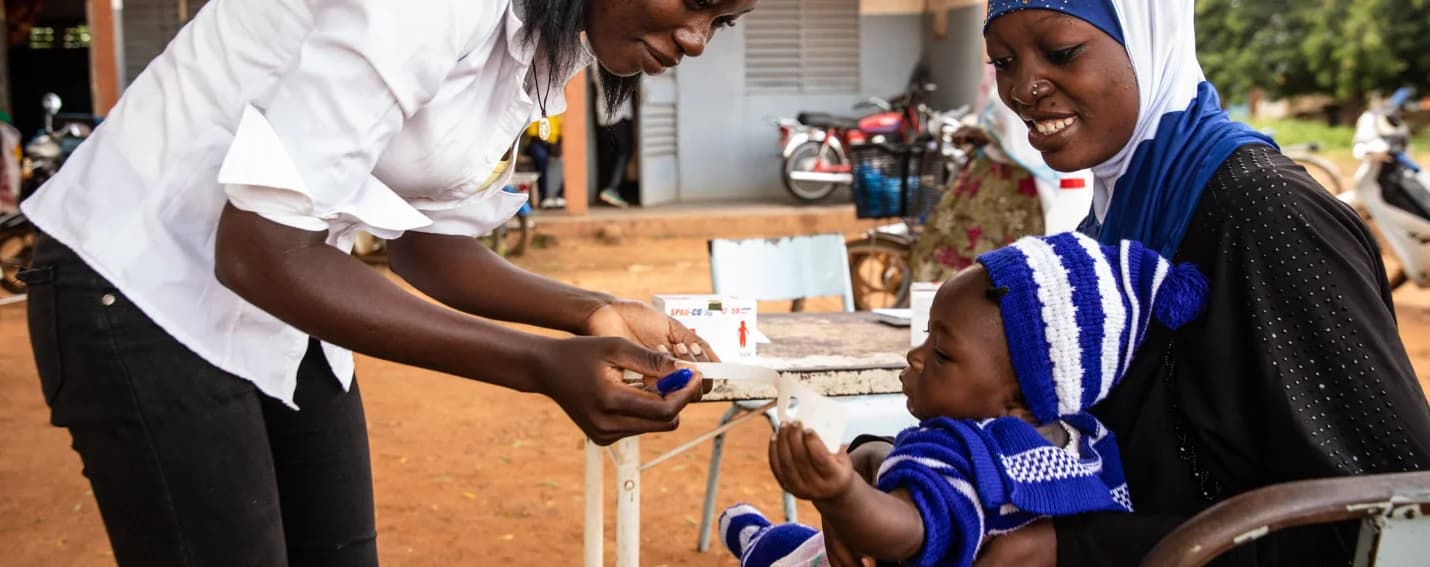
All Grants Fund

Short description
Continuously funds the programmes against extreme poverty that achieve the most per donation
GiveWell is a research organisation founded in 2007. It assesses which aid programmes against extreme poverty and the diseases that come with it achieve the most per donation, and publishes the calculation behind each assessment. The organisations it knows best, and whose impact it is most confident about, it lists as top charities, a short list of especially well-evidenced recipients.
The All Grants Fund is one of three giving funds GiveWell runs itself, and the broadest of them. It pools donations and passes them on continuously, to any funding opportunity that passes the assessment made by GiveWell, including opportunities outside the top charities. After transaction fees, 100% of donations go to the recipient organisations; GiveWell uses none of it for its own operations.1
Why the All Grants Fund matters
Extreme poverty is not a shortage of one thing but of many at once: food, clean water, vaccination, a clinic within reach. It therefore rarely kills under its own name, but through malaria, diarrhoea or a preventable infection.
More than four million children under five die each year in low- and middle-income countries, and most of those deaths are preventable.2
The shortage is not of effective programmes. It is of a way to choose between them. Restricting funding to a fixed list of vetted organisations is reliable, but it misses every opportunity that is new, unusual or time-critical: getting a better drug approved, moving a vaccine into a national programme, closing a funding gap that opens at short notice.
Those gaps have grown. In response to cuts to US foreign aid, GiveWell made 25 grants totalling around $53 million in 2025, about 13% of its grant funding, explicitly for needs the cuts created.3 So far this year, around $50 million has gone to needs of that kind.2
How the fund selects
Whether an opportunity is funded is decided by comparison with a very simple alternative: handing the same sum to very poor households as cash. How much more a programme achieves against that alternative gives a figure, and funding goes to everything above a threshold. In 2025 the threshold stood at 8 times; in early 2026 GiveWell lowered it to 6 times because projected funding had risen, and expects that to produce around $90 million in additional grants this year.2
The funding behind this grew again in 2026. In December 2025 Coefficient Giving, the renamed Open Philanthropy, committed $175 million to the recommendations made by GiveWell for 2026, and in July 2026 raised that commitment, together with Good Ventures, to $1 billion.4 GiveWell had already approved more than $400 million by the middle of the year and expects 2026 grantmaking to approach or exceed $1 billion.2 Coefficient Giving describes the increase explicitly as a one-off surge rather than a new steady state.4
The capacity behind this was built deliberately: the research team grew from 38 to 79 people in two years,2 and GiveWell launched more than 200 formal grant investigations in 2025.3
Because evaluation and grantmaking are not separated here, verifiability rests entirely on publication. GiveWell publishes a page with the reasoning and cost calculation for each grant, maintains a public database of all its grants, and keeps a standing page for its own mistakes.56
Who is supported
The fund is tied to no organisation. Among the grants GiveWell highlights on the fund page, all of them from 2022 to 2024:1
PATH
$18,205,272 to support the health ministries of Nigeria, the Democratic Republic of the Congo, Burkina Faso, Mozambique and Uganda in integrating the RTS,S and R21 malaria vaccines into their national immunisation programmes.1
Clinton Health Access Initiative
$15,092,329 for tuberculosis prevention for young children.1
Dimagi
$1,000,186 for a pilot of a platform that pays community health workers to deliver vitamin A and oral rehydration solution on door-to-door visits.1
Medicines Development for Global Health
$637,549 to complete WHO pre-qualification for moxidectin against onchocerciasis.1
New Incentives
$30,000,000 to expand the vaccination incentive programme. A top charity funded additionally from this fund.1
In its 2025 grantmaking year, running from February 2025 to January 2026, GiveWell approved 131 grants to 69 organisations totalling $418 million across 30 countries; the largest number of grants went to Nigeria, followed by India and the Democratic Republic of the Congo. Of that, $309 million went to programmes other than its top charities.3 These figures cover all the grantmaking done by GiveWell, not the All Grants Fund alone: the fund is one of several sources behind them, with $59 million in donations in metrics year 2024.7
Impact and transparency
There is no cost per life saved for this fund, because it grants across programmes with entirely different outcomes. What is published instead is again the ratio to the cash alternative: across all its 2025 grants, GiveWell estimates average impact at 16 times, roughly double the threshold then in force.3
Uncertainty is not a weakness of this fund but part of its design. GiveWell states that the individual grants are less proven, more experimental and less certain in their impact than its top charities, and points donors who want more certainty to the Top Charities Fund instead.1
Giving What We Can assessed GiveWell as an evaluator in 2025 and concluded that its recommendations and grantmaking approach are well suited to maximising the impact of a donation in global health.8 Effektiv Spenden also aligns its "Armut bekämpfen" giving fund with the All Grants Fund.9
One note on currency: the fund page carries a July 2025 date and shows examples from 2022 to 2024, while grantmaking has roughly doubled again since. The current picture is in the grants database, not on the fund page.15
Why the Wealth for the World Fund funds the All Grants Fund
In its work against extreme poverty, the Wealth for the World Fund relies on the research done by GiveWell. The reason is that this research can be verified: for every grant, the reasoning, the cost calculation and the underlying model are public, and decisions that turned out to be wrong are documented on a page of their own.56 Anyone who considers one of the assumptions wrong can replace it and recalculate the result for themselves.
GiveWell runs two funds against extreme poverty. The Wealth for the World Fund pays out to only one of them, the All Grants Fund. The Top Charities Fund supports the top charities alone,10 well-evidenced programmes that already receive payouts individually.11 The All Grants Fund can go further and also finance work that appears on no such list: building up a programme, getting a better drug approved, a funding gap that opens at short notice, or investigating an opportunity before anyone has funded it.1
It is precisely there that money is short. Evidence only accumulates once a first grant has been made, and while it is missing, an expense is hard to justify to a board or to one's own donors. Money therefore flows mainly to where impact has already been demonstrated, even though the same amount would achieve more elsewhere. The All Grants Fund uses that room and accepts a higher risk in return, a risk the Wealth for the World Fund carries deliberately.
What has to be demonstrated is not each individual grant but the procedure by which they are selected. The threshold above which anything is funded at all is a published figure, and the average of a whole grant year is measured against the same alternative as every single grant: in 2025 that average stood at 16 times, roughly double the threshold in force at the time.3
Footnotes
-
GiveWell, "All Grants Fund". givewell.org ↩ ↩2 ↩3 ↩4 ↩5 ↩6 ↩7 ↩8 ↩9 ↩10
-
GiveWell Blog, "Scaling Our Impact, with Support from a $1 Billion Commitment", 23 July 2026. blog.givewell.org ↩ ↩2 ↩3 ↩4 ↩5
-
GiveWell Blog, "GiveWell's 2025 Grantmaking: Record Grants, Expanded Reach, Crisis Response", 26 February 2026. blog.givewell.org ↩ ↩2 ↩3 ↩4 ↩5
-
Coefficient Giving, "Increasing Our 2026 Allocation to GiveWell's Recommendations to $1 Billion", 23 July 2026. coefficientgiving.org ↩ ↩2
-
GiveWell, "Our Giving Funds". givewell.org ↩ ↩2 ↩3
-
GiveWell, "Our Mistakes". givewell.org ↩ ↩2
-
GiveWell, "GiveWell's Impact". givewell.org ↩
-
Giving What We Can, "GiveWell: All Grants Fund". givingwhatwecan.org ↩
-
Effektiv Spenden, "Spendenempfehlungen 2025", 19 December 2025. effektiv-spenden.org ↩
-
GiveWell, "Top Charities Fund". givewell.org ↩
-
GiveWell, "Our Top Charities". givewell.org ↩
All Donation Partners
Discover all organizations supported by Wealth for the World
Support All Grants Fund
With your donation to Wealth for the World, you can sustainably support All Grants Fund and other effective organizations
Organization's Website
Learn more about the mission and impact of All Grants Fund directly on their website
Related Articles
Loading related articles...