Wealth for the World Donation Methodology
Wealth for the World donates two percent of its assets annually
Our goal is to do as much good as possible with every donation over time. Behind this lies the idea of patient philanthropy1: instead of paying out incoming donations in full right away, we invest them and pass on a fixed share each year. This builds up a fund that continuously does good through its steady payouts. What matters is not the individual annual payout, but that the sum of all payouts is maximized over the long term.
Concretely, each year we distribute two percent of the fund's assets to effective donation partners. These payouts are offset by an expected annual return of around seven percent2, so that on balance the assets grow by about five percent per year. Over the years this creates a compound interest effect through which the fund can distribute more in the long run than was ever paid into it.
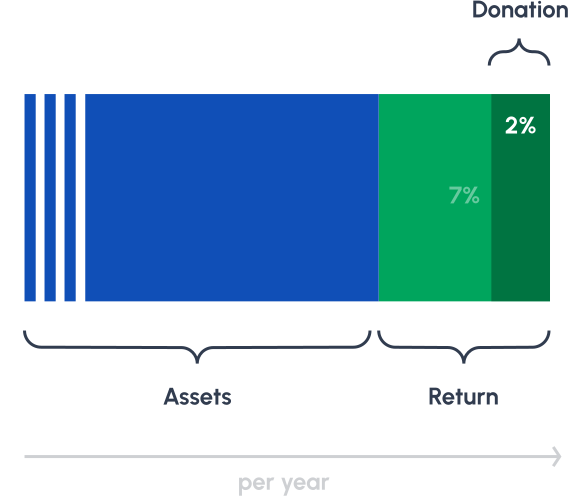
Why exactly two percent? The rate is the result of an economic optimization3 that weighs earlier against later impact: a higher rate gets more money to our donation partners sooner but slows the fund's growth; a lower rate lets the assets grow faster but defers the payouts into the future. At two percent, the total sum of all payouts over the fund's lifetime is greatest. The calculation factors in the expected capital return, the diminishing marginal utility of additional donations, and the risks of delayed payments.
You can find our model for calculating the optimal donation rate here.
A key advantage of the fixed rate: we pay out even in loss years, precisely when donation partners are often under the greatest funding pressure4. This keeps the disbursements smooth and reliably predictable, rather than tied to individual stock-market years.
The long-term impact of a donation
Assumption: 7% real growth p.a. with disbursements of 2% of assets p.a.
- No market timing. We focus on long-term growth instead of reacting to short- or medium-term fluctuations.
- No active stock-picking. We track the market purely via ETFs (70% MSCI World ESG, 30% MSCI Emerging Markets ESG).
- No special distribution in crises. It stays at two percent.
- No reduction in good years. Even at a very high return, only two percent is paid out.
- No erosion of capital. The expected return (7%) is well above the distribution rate (2%).
From 2016 to 2023, 70% of the fund's positive annual return was distributed each year, and nothing in loss years. In 2024 we switched to the fixed two-percent rule for two reasons:
- Procyclical giving is suboptimal. The old rule paused in loss years (2018, 2022), exactly when the need for donations is highest.
- Erosion of capital in volatile phases. When the market recovered after overshooting on the downside, the old rule distributed 70% of that pure rebound, drawing down capital instead of real return.
More details in our Annual Report 2023.
References
- More on this in our donation guide: “Why it can pay to be patient when giving”. The idea of patient philanthropy (investing donations and paying them out only later) is not new; a classic example are Benjamin Franklin's bequests (1790), whose capital grew over up to 200 years. The modern economic case our model builds on comes above all from Philip Trammell at the Global Priorities Institute, University of Oxford. ↩
- Historical equity returns allow reasonable inferences about future returns. A widely cited paper studies the long-run real returns on all major asset classes, among them equity. Based on data from 16 advanced economies between 1870 and 2015, the average real return on equity is estimated at 7%. We therefore assume an expected return of 7%. ↩
- The model we use to calculate the optimal rate is available as an interactive Google Colab notebook. ↩
- The need for charitable support tends to rise in economically weak years, while private donation income declines at the same time. See for example Andreoni (2011), “The Market for Charitable Giving”, Journal of Economic Perspectives 25(2), 157–180. ↩